
Reference Projects in Supplier Selection for a Subscription Scent Brand
A subscription brand buys the same thing over and over, so the question a reference project has to answer is not whether a supplier can deliver one good launch but whether it can deliver the fifth one at the same standard. Most reference material is built to prove the first. That mismatch is why subscription brands get misled by impressive portfolios, and why the checklist below focuses on cadence, capacity and consistency rather than on creative range.
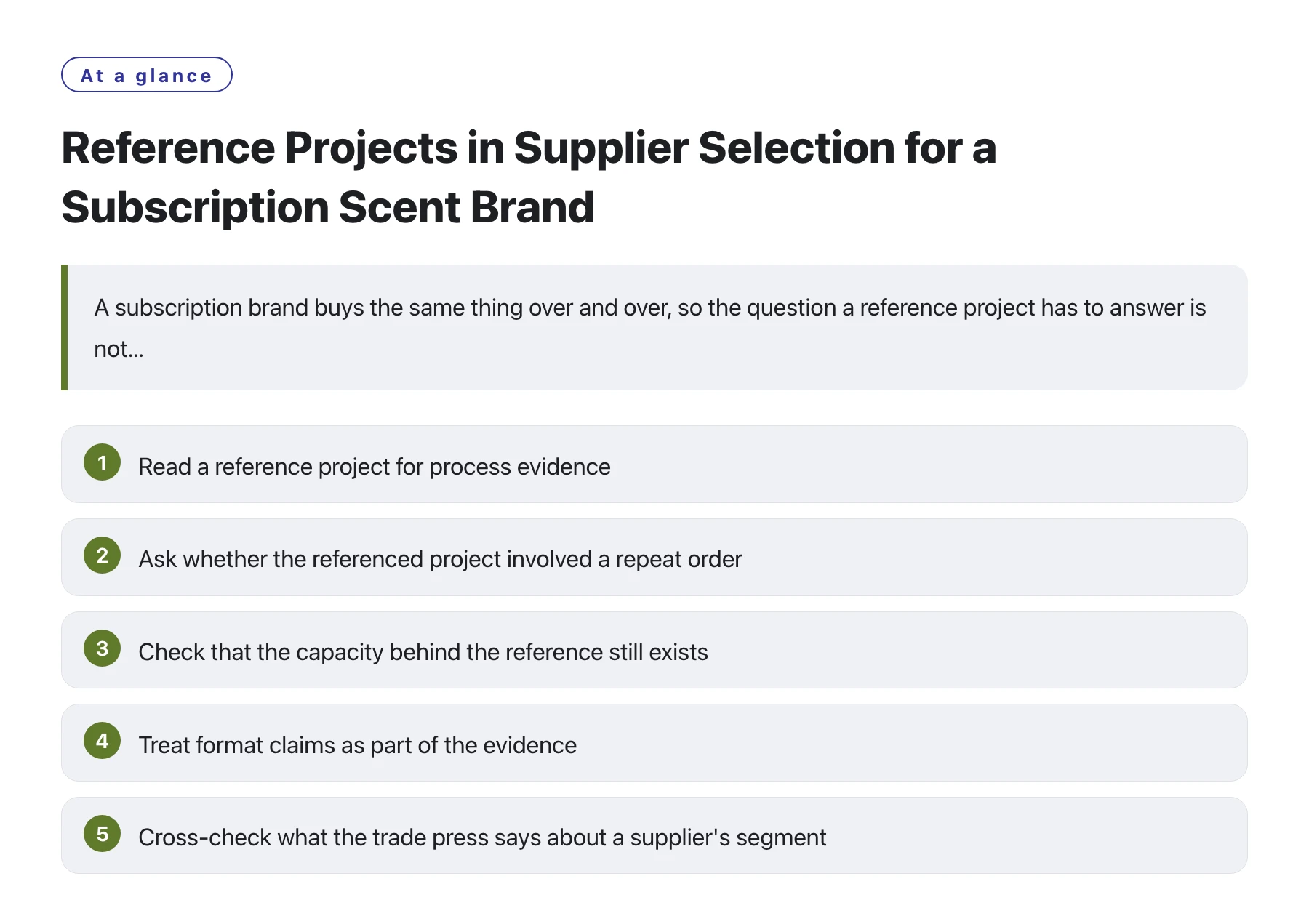
Key takeawaysRead a reference project for process evidence, such as batch records and repeat runs, rather than for the finished object in the photograph. · Ask whether the referenced project involved a repeat order, because a subscription model lives entirely in repeat orders. · Check that the capacity behind the reference still exists, since a project delivered three years ago may rest on people or a line that has since changed. · Treat format claims as part of the evidence, as the fragrance category is increasingly framed around formats and refill models rather than scent alone [1]. · Cross-check what the trade press says about a supplier's segment, because coverage patterns reveal which category a manufacturer is genuinely built around [2].
Subscription fragrance models depend on a supplier being boringly reliable. The scent has to arrive the same way every cycle, the pack has to survive a postal journey, and the batch records have to let a brand answer a complaint about order number nine without rebuilding the file from emails.
Reference projects are the closest thing to a preview of that behaviour, but only if they are read for the right signals. This checklist is ordered from the easiest claim to verify to the most revealing.
A buyer's checklist for reading reference projects
- Ask what the project actually involvedScope, format, volume and duration. A project described only as a brand collaboration is not evidence of anything, and the answer to this question usually reveals how much detail the supplier keeps.
- Ask whether this was a first order or a repeatFor a subscription brand this is the decisive question. A supplier that can point to customers who reordered repeatedly is showing a different capability from one with a portfolio of one-off launches.
- Ask what changed between the first and the latest orderFormula tweaks, component substitutions, supplier changes. Repeat orders are where consistency is either maintained or quietly lost, and the answer describes the supplier's real process.
- Ask who owns the artwork and the toolingIf the pack is specific to the brand, confirm who holds the tool and what happens to it if the relationship ends. This matters more in a recurring model than in a single launch.
- Ask for a capacity statement for your cadenceNot total capacity, but capacity at your order size and rhythm. A supplier that runs large seasonal batches may find a small monthly run awkward even when the annual volume is similar.
- Ask how a past complaint was handledPick a scenario and ask for the process rather than a story. The structure of the answer shows whether there is a deviation procedure or an improvisation.
- Ask what the reference project would do differently nowA supplier with a real quality culture has an answer. A supplier without one describes the project as flawless, which is a stronger warning than any gap in the portfolio.
What a reference project proves, and what it does not
| What the reference shows | What it does not show | How to close the gap |
|---|---|---|
| A finished fragrance reached the market | That the same standard holds on order nine | Ask for repeat-order records and retention samples |
| The supplier can execute a given pack | That the pack survives postal handling | Request shipping and compatibility data for the retail format |
| A formula was developed and approved | That batch variation stays inside tolerance | Review the tolerance statement and release process |
| A project ran to a date | That the date is repeatable at your cadence | Ask for a capacity statement at your order size and rhythm |
| A brand was willing to be named | That the relationship ended well | Ask what the supplier would change about the project now |
The right-hand column is the whole exercise. A reference project is a starting question, never a conclusion.
Why subscription models need different evidence
Consistency is the product
In a one-off launch, a small variation between batches is a curiosity. In a subscription, it is the product experience: a subscriber who receives a slightly different scent in month four notices, because the previous month is still on the shelf, and the comparison happens without any laboratory. Consistency is therefore worth more than novelty in the selection criteria.
This changes how a supplier should be scored. Development range is a nice attribute; batch control, retention discipline and a documented tolerance band are the attributes that decide whether the model works, and they are exactly the attributes a glossy portfolio does not display.
Cadence is a production question
Monthly fulfilment and quarterly fulfilment are different manufacturing problems even at the same annual volume. Small, frequent runs put pressure on changeover discipline, on component availability and on inspection, and a supplier organised around large seasonal campaigns may handle the annual total easily and the monthly rhythm poorly.
So ask the capacity question in the units the model uses: units per cycle, cycles per year, and the minimum run the line is comfortable with. A supplier that answers in annual tonnage has not answered.
Packaging has to survive the last mile
Subscription fulfilment usually ends at a letterbox or a doorstep rather than a counter, so leakage, seal integrity and decoration durability carry more weight than shelf presence. That is a different test from the one a retail launch requires, and it should appear in the supplier's programme rather than being inferred from a bottle that looks robust.
It also affects the refill model. Where a subscription sends a refill rather than a full pack, the compatibility between the refill container and the concentrate becomes a recurring question instead of a one-time check.
Turning the answers into a decision
By the end of the checklist, the brand should have three things per candidate supplier: a named reference with a scope, a statement about repeat behaviour and a capacity position at the required cadence. Suppliers that cannot provide all three are not disqualified, but the missing piece has to be treated as a risk with a mitigation rather than as a detail to be resolved later.
It also helps to see how a supplier frames the projects it is proud of. Following Learn more into a manufacturer's case pages shows what that company considers evidence, and for a subscription brand the useful question is whether the framing mentions repetition and control or only reach and creativity.
For smaller houses and independent brands, the relevant evidence set is narrower but not weaker. What a young label needs from a factory is often a short minimum, a workable small-run rhythm and clear documentation, and a reference project that demonstrates those is more useful than a large campaign that demonstrates neither. Industry material on Xuelei's guide covers that ground directly.
Where the brand intends to follow the supplier's own concept rather than develop from scratch, the selection question shifts again, because the supplier's library and its readiness to adapt become the product. Reading what an an ODM partner for fragrance brands is expected to provide is a sensible way to set expectations before the checklist is applied.
Keep the completed checklist as a file. Two cycles into the relationship it becomes the baseline for reviewing whether the supplier has kept the promises that won it the work, and that review is far easier with the original answers on hand.
Score suppliers on three questions about repetition, not on ten about creativity. A subscription brand is buying the tenth delivery, not the first.
Sources
- Mintel Press Centre —— Mintel's press releases on consumer and beauty market research, including fragrance and personal care trend reporting.
- Cosmetics Business —— A trade publication covering the beauty and cosmetics industry, including fragrance launches and regulatory developments.
Frequently asked questions
Do we need to visit a factory to check repeat capability?
A visit helps but is not decisive. Retention samples, repeat-order records and a capacity statement at your cadence answer the repeatability question more directly than a tour.
How many reference projects should we ask about?
Two or three, chosen to include at least one repeat customer. Ask the same questions about each so the answers can be compared.
What if a supplier will not name clients?
Ask for an anonymised project description with scope, format and repeat behaviour. Confidentiality is a legitimate reason to withhold a name; it is not a reason to withhold everything.
Is a large manufacturer better for a subscription model?
Not necessarily. The fit depends on whether the supplier's organising rhythm matches yours, and some smaller operations handle monthly runs better than large seasonal ones.
How do we verify a supplier's capacity claim?
Ask what share of the line your order would occupy, and what the lead time looks like in the supplier's busiest month rather than in an average month.
The smart money playbook for first-time founders.
Join 240,000 founders who read First Capital every week. Free, candid, mentor-like — never sponsored.
Get the Founder's First-Capital Playbook