
Custom Jewelry Wholesale: First Order, Repeat Order
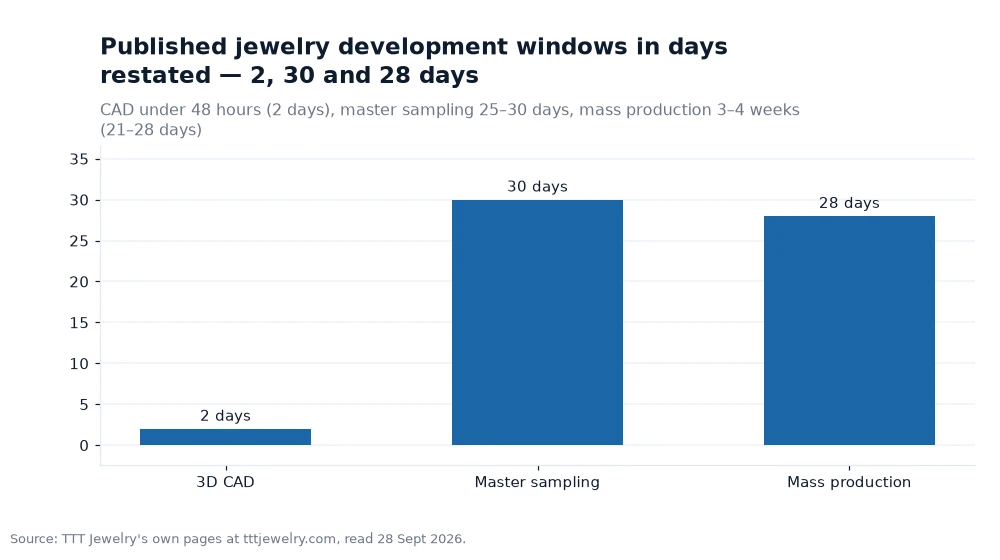
A first order builds the tooling; every order after it uses the tooling. That single difference explains the calendar: the first run carries 2 days of CAD, 30 days of master sampling at the slow end and 28 days of production, while a repeat goes straight to a 3–4 week production window. Knowing which costs belong to which order is how a brand plans a second season without paying twice.

Key takeaways
- A first order carries CAD at 2 days and sampling at up to 30 days before production starts.
- A repeat order skips both stages and runs at the published 3–4 week production window.
- Tooling, CAD files and the collection stay exclusive to the buyer under 100% NDA terms.
- The MOQ by base material is 100 units in eco-brass, 50 in 925 sterling silver and 100+ pcs in stainless, per design, so a two-design range doubles those figures.
What the first order is actually paying for
Tooling is the invisible line in a first quotation. Before any piece can be produced in quantity, the design has to be modelled in CAD under 48 hours, approved dimensionally, then built as a master sample across 25–30 days of wax printing, casting, stone setting, polishing and plating.
That stage exists once per design. The mould that comes out of it is what the bulk run uses, and under the published NDA terms it is not reused for another brand.
So a first order buys two things: the pieces, and the capacity to make more of them. A brand that only compares unit prices between a first order and a catalogue purchase is comparing a piece of tooling against a box of stock.
What a repeat order skips entirely
A repeat order opens at bulk production, because the specification is already frozen. The base metal, the plating stack, the stone, the hallmark and the packaging were all agreed before the master sample was approved, so nothing needs to be re-decided.
That is a 3–4 week window rather than the roughly 8 to 9 weeks a first order occupies. The saving is not a discount, it is the removal of two stages from the calendar, and it is the reason a second season can open sooner than the first one did.
The one thing a repeat order does need is the record. Plating recipes, stone lots and engraving files are what make the second run identical, and a brand that kept its own copy of the approved specification can check the second batch against it.
The published reason a repeat can skip those stages is that the master sample becomes a physical benchmark: the line states that the approved master sample is the reference used on later orders, with the same material sourcing and the same surface standard, so that batch #10 matches batch #1. A repeat order therefore starts from a sample on the shelf as well as from a file.
Set against the line's five service steps — concept and design, master sampling, quality inspection, sample confirmation, mass production — a repeat order enters at the final step and uses the output of the earlier four as its reference.
The same tooling on a different calendar
Written as days, the difference is easy to see. A first order is 2 days of CAD, up to 30 days of sampling and up to 28 days of production: 2 + 30 + 28 = 60 days. A repeat order is the 28-day production window on its own.
The second run therefore occupies 28 ÷ 60 = 46.7% of the first run's calendar. The arithmetic is mine; the 48-hour, 25–30 day and 3–4 week windows are published figures.
Nothing about the pieces changes between the two orders. What changes is how much of the calendar is spent deciding rather than making.
Reordering without reopening the design
The most common expensive habit in custom jewelry wholesale is reopening a design between the sample and the first production run. Once the mould exists, a change to the plating or the stone means rebuilding the piece rather than editing it.
The published option summary at www.tttjewelry.com/custom-jewelry-wholesale/ is worth holding against the approved specification before a reorder, because it lists the six decision points that have to stay stable for a repeat to be a repeat.
Where a change is genuinely needed, the cheaper route is a new design. A second mould on a related silhouette costs less in calendar time than reopening the first one after tooling.
MOQ across a first and a second order
Published minimums are 100 plus in stainless, 50 in 925 sterling silver and 100 pcs in artisan eco-brass, by design. They apply to the first order and to each design within it, not to the brand's lifetime volume.
For a first season, that argues for fewer designs at a higher price point, where 50 pieces per design is a realistic sell-through. For a second season, the same minimum applies to designs that already have sales data behind them, which makes a wider range far less risky than it was the first time.
One caution worth writing down: a reorder of an existing design does not reset the mould, but a change to the base metal does. Moving a design from silver to steel is a new design for tooling purposes.
Planning two seasons at once
Once the first order is in production, the second order's calendar can be planned with an accurate number. The published 3–4 week production window is the whole lead time for a repeat, so a reorder placed to arrive before a seasonal peak can be dated backwards from the ship date rather than guessed.
That is also when the next designs should enter CAD, because the 48-hour CAD stage and the 25–30 day sampling window can run while the first batch is in production.
Staggering the two keeps tooling spend spread across the calendar rather than clustered at the start of every season, and it keeps the workshop working on one design at a time.
| Order type | Published stages | Calendar in days |
|---|---|---|
| First order, fast end | CAD, sampling, production | 2 + 25 + 21 = 48 |
| First order, slow end | CAD, sampling, production | 2 + 30 + 28 = 60 |
| Repeat order | production only | 21–28 |
| MOQ per design | 50 / 100 / 100+ pcs by metal | fixed per design |
Worked example: the repeat order as a share of the first
Add the slow-end published windows in days. CAD is under 48 hours, which is 2 days. Sampling is 25–30 days, taken at 30. Production is 3–4 weeks, which is 21–28 days, taken at 28. The first order totals 2 + 30 + 28 = 60 days.
A repeat order is production only, so it is 28 days, which is 28 ÷ 60 = 46.7% of the first-order calendar at the slow end. At the fast end the same comparison is 21 ÷ 48 = 43.8%.
Both ratios use published windows and my own arithmetic. They are the clearest argument for ordering a proven design twice rather than developing a new one under time pressure.
Frequently asked questions
Why is a repeat order faster than a first order?
Because the CAD stage and the 25–30 day sampling window belong to the first order. A repeat goes straight to the published 3–4 week production window.
Do minimums apply again on a reorder?
Floors are 100 pcs in eco-brass, 50 pcs in sterling silver and 100 plus in the stainless line, design by design, which doubles again for a two-design range.
Can a design be changed between the first and second order?
It can, but a change to the base metal or the plating means new tooling. In practice a related new design costs less calendar time than reopening an approved one.
Making the second order cheaper than the first
The saving on a repeat order is structural, not commercial: two published stages disappear because the tooling exists. Everything that keeps them gone — the mould, the CAD file, the plating recipe — is covered by the production step list, which is worth reading once before the first order is placed and again before the second.
For a reorder on a plated line, the eco-brass and plating options are the specification to re-confirm, because a change of finish between batches is the one revision that shows up immediately to a returning customer.
The details quoted above — the three specialised services as well as the confidentiality terms and the five-stage service route — trace back to the factory's own site at tttjewelry.com itself, in a visit dated 28 Sept 2026. The unit conversions are my own working[1].